...comes a bit of literary criticism.
"A badgered musicality: the snake as threat in light of Munroe's trochee theory"
(See also the to-do list.)
Saturday, April 23, 2011

Wednesday, March 16, 2011
Giraffe
Жираф
Сегодня, я вижу, особенно грустен твой взгляд
И руки особенно тонки, колени обняв.
Послушай: далёко, далёко, на озере Чад
Изысканный бродит жираф.
Ему грациозная стройность и нега дана,
И шкуру его украшает волшебный узор,
С которым равняться осмелится только луна,
Дробясь и качаясь на влаге широких озер.
Вдали он подобен цветным парусам корабля,
И бег его плавен, как радостный птичий полет.
Я знаю, что много чудесного видит земля,
Когда на закате он прячется в мраморный грот.
Я знаю веселые сказки таинственных стран
Про чёрную деву, про страсть молодого вождя,
Но ты слишком долго вдыхала тяжелый туман,
Ты верить не хочешь во что-нибудь кроме дождя.
И как я тебе расскажу про тропический сад,
Про стройные пальмы, про запах немыслимых трав.
Ты плачешь? Послушай... далёко, на озере Чад
Изысканный бродит жираф.
Сегодня, я вижу, особенно грустен твой взгляд
И руки особенно тонки, колени обняв.
Послушай: далёко, далёко, на озере Чад
Изысканный бродит жираф.
Ему грациозная стройность и нега дана,
И шкуру его украшает волшебный узор,
С которым равняться осмелится только луна,
Дробясь и качаясь на влаге широких озер.
Вдали он подобен цветным парусам корабля,
И бег его плавен, как радостный птичий полет.
Я знаю, что много чудесного видит земля,
Когда на закате он прячется в мраморный грот.
Я знаю веселые сказки таинственных стран
Про чёрную деву, про страсть молодого вождя,
Но ты слишком долго вдыхала тяжелый туман,
Ты верить не хочешь во что-нибудь кроме дождя.
И как я тебе расскажу про тропический сад,
Про стройные пальмы, про запах немыслимых трав.
Ты плачешь? Послушай... далёко, на озере Чад
Изысканный бродит жираф.
Nikolai Gumilev, 1908
Giraffe
This evening the look in your eyes is especially sad,
And your arms are especially vine-like entwining your calf.
So listen to me: far away, on the shores of Lake Chad
There roams an exquisite giraffe.
He is gracefully slender and gifted with bliss from within,
And none on the Earth dares to equal him, only the moon
Will stencil the magical patterns that cover his skin
As it shatters and floats on the mists of a spacious lagoon.
From afar he resembles a caravel's colorful sails,
And his canter is smooth like exuberant avian flight.
I know that the earth holds a hundred miraculous tales
And your arms are especially vine-like entwining your calf.
So listen to me: far away, on the shores of Lake Chad
There roams an exquisite giraffe.
He is gracefully slender and gifted with bliss from within,
And none on the Earth dares to equal him, only the moon
Will stencil the magical patterns that cover his skin
As it shatters and floats on the mists of a spacious lagoon.
From afar he resembles a caravel's colorful sails,
And his canter is smooth like exuberant avian flight.
I know that the earth holds a hundred miraculous tales
Of when he retires to a grotto of marble at night.
I know merry tales from mysterious lands, and a song
Of a maiden's dark cheeks, with a chieftain's desires for refrain,
But you have inhaled the dank lead of the fog for too long,
You will not believe any sound but the patter of rain.
And how will I tell you of tropical gardens all clad
In vines, slender palms, pungent grasses the wind bends in half?
You're crying? But listen to me... far away, on Lake Chad
There roams an exquisite giraffe.
I know merry tales from mysterious lands, and a song
Of a maiden's dark cheeks, with a chieftain's desires for refrain,
But you have inhaled the dank lead of the fog for too long,
You will not believe any sound but the patter of rain.
And how will I tell you of tropical gardens all clad
In vines, slender palms, pungent grasses the wind bends in half?
You're crying? But listen to me... far away, on Lake Chad
There roams an exquisite giraffe.
Unlike the previous poem, this one has been translated many times, for example (as I just found via a Google search) by Stephen Dodson, a.k.a. language hat. My own translation dates from November, although for some reason I hadn't posted it until now. Apparently Dodson and I came to some startlingly similar solutions (caravel? really?)
The Bagel
Бублик
О бублик, созданный руками хлебопека!
Ты сделан для еды, но назначение твое высоко!
Ты с виду прост, но тайное твое строение
Сложней часов, великолепнее растения.
Тебя пошляк дрожащею рукой разламывает. Он спешит.
Ему не терпится. Его кольцо твое страшит,
И дырка знаменитая
Его томит, как тайна нераскрытая.
А мы глядим на бублик и его простейшую фигуру,
Его старинную тысячелетнюю архитектуру
Мы силимся понять. Мы вспоминаем: что же, что же,
На что это, в конце концов, похоже,
Что значат эти искривления, окружность эта, эти пятна?
Вотще! Значенье бублика нам непонятно.

*I think birthdays should have a 15% error margin.
О бублик, созданный руками хлебопека!
Ты сделан для еды, но назначение твое высоко!
Ты с виду прост, но тайное твое строение
Сложней часов, великолепнее растения.
Тебя пошляк дрожащею рукой разламывает. Он спешит.
Ему не терпится. Его кольцо твое страшит,
И дырка знаменитая
Его томит, как тайна нераскрытая.
А мы глядим на бублик и его простейшую фигуру,
Его старинную тысячелетнюю архитектуру
Мы силимся понять. Мы вспоминаем: что же, что же,
На что это, в конце концов, похоже,
Что значат эти искривления, окружность эта, эти пятна?
Вотще! Значенье бублика нам непонятно.
Nikolai Oleinikov, 1932

The Bagel
O Bagel, loving breadmaker's creation!
Though you are meant as food, how lofty is your station!
Though simple you may seem, your structure's mystery
Is finer than a watch, more splendid than a tree.
The humdrum crumbles you with trembling hands. He rushes.
He cannot wait. He fears your ring. It crushes
Him, and the famous hole
With unsolved mystery weighs down his soul.
But we behold the bagel and we strive to make conjectures
About its simple shape, its thousand-year-old architecture.
What is it, what, we struggle to recall,
What's so familiar about it all?
This curvature, these spots, this roundness -- what is their intention?
In vain! The bagel is beyond our comprehension.
Nikolai Oleinikov was an editor of magazines for children and one of the lesser-known members of the Oberiu group of early Soviet poets. He was born in 1898 and killed in (guess...) 1937, and his short oeuvre was largely unpublished until perestroika. And for good reason: its studied naiveté is a vehicle for parody and mockery, the greatest enemy of ideologues everywhere. For those with JSTOR access, here is a pretty lucid discussion of Oleinikov and his work in English (though with unglossed poems.)
As far as I can tell, his collection, Пучина страстей (The Abyss of Passions), has never been published in English; only a few poems have been translated and published in magazines and on the Internet. "The Bagel" is now one of them.
For what it's worth, Wikipedia in its multilingual wisdom informs me that a bublik is not the same as a bagel, but I'm guessing there are no places outside of maaaybe Brooklyn where you might get confused.
As far as I can tell, his collection, Пучина страстей (The Abyss of Passions), has never been published in English; only a few poems have been translated and published in magazines and on the Internet. "The Bagel" is now one of them.
For what it's worth, Wikipedia in its multilingual wisdom informs me that a bublik is not the same as a bagel, but I'm guessing there are no places outside of maaaybe Brooklyn where you might get confused.
*I think birthdays should have a 15% error margin.
Friday, March 4, 2011
This was written around February 15
Since then winter has poked its head back in the door. I'm so bad at this blogging thing.

Mirrors in Springtime
Who do you think you are, here, shoveling the sea,
Churning the sky to whip up butter-clouds,
Scrunching its blade into a funhouse grimace
To shove it through the gullet of the earth?
There's no going back!
You can't mop up the spring. You can't sand off
The rivery veneer that covers winter's vigor
Even to bare its murky cotton bones,
But there rush in chattering brief brilliant shards:
This is it. Throw down your antiquated instruments.
Suffer it to thunder by,
Until the world falls, dry and docile, in your lap.
Churning the sky to whip up butter-clouds,
Scrunching its blade into a funhouse grimace
To shove it through the gullet of the earth?
There's no going back!
You can't mop up the spring. You can't sand off
The rivery veneer that covers winter's vigor
Even to bare its murky cotton bones,
But there rush in chattering brief brilliant shards:
This is it. Throw down your antiquated instruments.
Suffer it to thunder by,
Until the world falls, dry and docile, in your lap.

Wednesday, February 16, 2011
A post I would've written in December but didn't because I didn't (and still don't) have the right picture
But here is the wrong picture:

Жарко. Ветер. Меткими бомбамиAnd in English, it went like this:
С платанов обрушиваются листья, оглушительно шурша.
Где-то тут затерялось время.
Под каким листом оно спрятано?
Somewhere above there's a breeze. With bomb-like precision,Even if you don't speak either language (in which case you're probably not reading this) you can see that these are not entirely equivalent pieces of text. Yet I claim that they are the same poem: they express the same set of concepts that happened to be in my head at the time. Certain techniques match -- it's fortuitous that there was enough onomatopoeia in both languages for the concepts in the second line -- but in other places the two diverge, for example in the first line, where they leave different details unspoken, to be reconstructed from the rest of the scene. This sort of self-analysis is what has convinced me that translating free verse must be excruciatingly hard -- perhaps harder than metered poetry, and certainly much harder than prose. Not that I've tried it. But the relation of the meaning of a poem to the meanings of its words and phrases is decidedly nontrivial.
Leaves hurtle from the trees, rustling thunderously.
Somewhere here I lost track of time.
Do you know which leaf it's hidden under?
In Le Ton beau de Marot, Hofstadter pours a great deal of invective on Dylan Thomas' “How Soon the Servant Sun,” claiming that it is untranslatable because it's meaningless. Now, this poem is obscure, but it's clearly not meaningless. You can call it bullshit, sure -- in other words you can question how much of the meaning was intended by the poet -- but meaning (some of it, of course, personal to the reader) is still there in spades if you look for it rather than purposely sweeping it away.
Anyway, Hofstadter also gives an example of a French translation of this poem that I remember being far too true to the words to be true to the sense. To me, the real moral of the story is that to translate a poem like this you really need to internalize its concepts and write a new poem that encompasses the same meaning, without trying to map words to words.
I haven't tried to analyze “How Soon the Servant Sun” in detail. If I did, the output would be a translation to Russian. It's not that I think that analyzing the meaning of a poem through prose is always inappropriate, but it's not what I want to do with my life or these pages.
So, a future project?
Remission statement
I realized eventually that if you try to set yourself limits on what to blog, you never blog anything. Wait, let me try this again. If I try to set myself limits on what to blog, I end up abandoning the blog entirely. So I will now blog whatever I feel like putting out there. And if there aren't enough pictures, well, so be it.

Thursday, June 3, 2010
Aspirations
What I hoped to see in Alaska.
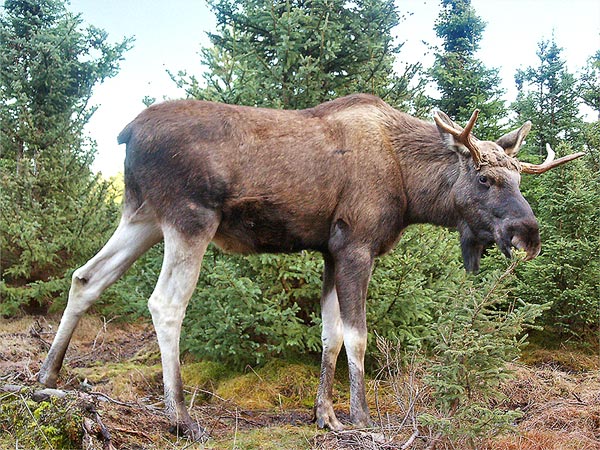
What I actually saw.


What was hiding behind the trees the whole time (artist's reconstruction.)
 For what I really found in Alaska, see here.
What I actually saw.

What was hiding behind the trees the whole time (artist's reconstruction.)

Subscribe to:
Posts (Atom)
